Each year, the sixth grade students at our school lead a Shabbat morning service. They read from the Torah, lead the prayers and blessings, and share their ideas about the concepts behind the service. All this is the result of a great deal of preparation in class; students learn trope so that they can read from the Torah, reflect and write about the meaning of prayers and their connections to them, and learn the words and melodies to familiar and unfamiliar prayers.
We have struggled with this in the past--devoting so much time in class for what on some level looks like rote learning (when, at our cores, we are very invested in the constructivist/critical thinking learning models)--but there is no doubt that the result is always beautiful and transcendent.
We were trained in the Understanding by Design method--a model of teaching and learning that posits assessments must be authentic i.e. like a real-world situation in order for them to have meaning, retention, and transference for the students.
That being said, isn't this Shabbat service the most authentic of assessments? Despite the fact that it looks like memorization, students are learning the skills to participate in any Jewish Shabbat service that they attend. This skill they will use in the next year --which will bring them many many Bnai Mitzvah services and celebrations-- but even more so, this is a skill they can use the rest of their lives.
It raises the constant tension in Jewish education about keva (routine) vs. kavannah (spirituality). Sometimes there is a benefit in just learning the motions-- because once you learn the motions, then you can start thinking on a higher level and bring yourself to a deeper spiritual place. It is hard to reach a place of meaning during a worship service if you are stumbling through the words, or feel unsure of yourself. Now that our students have honed their skills at participating in a Shabbat service, they are in a place where they will be better setup to find that spiritual place as they mature.
Showing posts with label UBD. Show all posts
Showing posts with label UBD. Show all posts
Thursday, March 21, 2013

Thursday, December 20, 2012
Crafting Lesson Plans
Many teachers struggle with the line between crafting good lessons plans and staying spontaneous in the classroom--whether or not to allow students' needs to dictate the lesson.
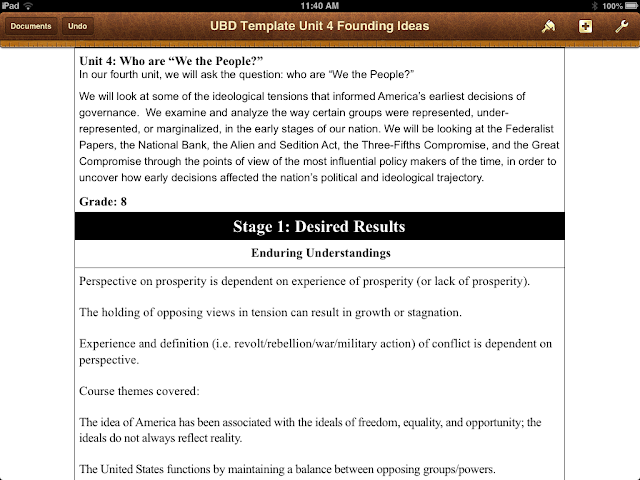
Click here for access to any of our unit overview pages for U.S. history; please understand that these are, as always, works in progress. We would love any constructive feedback anyone has for us.
Step Two: Smartboard
We are lucky enough to work in a school that has Smartboards installed in every classroom; this is, of course, not the case for everyone. Smartboard software is great for scripting out lesson plans because it allows for a screen-shade to hide and then reveal parts of a lesson on a single page. Another collaborator we worked with to craft these units and lessons (giving credit here to Aaron Brock for helping to craft this U.S. history curriculum) scripted these lessons out in Powerpoint for use in his classroom.
We script our lessons out on Smartboard software because it allows us to stay on track--unless we purposefully decide to take the lesson in another direction for clarification purposes or student need.
Another MAJOR advantage of scripting lessons out is that students are able to see the question that is being asked, as well as hearing it. Teachers don't have to turn their backs on students to write directions out on the board and don't have to remind students of what question they are meant to be discussing over and over. We have found this to be incredibly helpful with all students, but obviously most for students who have auditory processing challenges.
A usual lesson will contain an anticipatory set that is usually constructivist in nature (not always of course)--something that will get students' attention, activate prior knowledge, and give a thematic taste of the lesson's contents. Then, the meat of the lesson is scripted out using the Smartboard software. A copy of a "normal" lesson can be found here.
Our lessons tend to be experiential and collaborative; students work together to uncover information. The teacher is not seen as the source of information, but rather a facilitator.
The lesson ends with some kind of closure: a discussion, reflective writing, exit cards etc. in order to assess and wrap-up the day's concepts. The closure, as with the rest of the lesson, is scripted out so that any directions the students are following, or questions the students are answering are right there.
Lessons are always scaffolded so that the smaller parts of the unit come together for the larger assessment at the end; it is the goal that each lesson is a smaller piece in the larger unit puzzle. This culminates in the unit assessment.
Step Three: Haiku
Our middle school utilizes the Haiku Learning Management Program (more about the benefits of that later) in order to convey course material to students, and to provide a platform for in class and out of class interactions. As such, all of our course materials that are intended for students (lessons, handouts, directions, readings, images, videos, links, etc.) are found on our course Haiku page.
This allows for students to review lessons, activities, or catch up due to absence.
As the UBD overviews are not for students, they are not made available for them to see.
Step Four: The Purple Notebook
For such big proponents of tech, our method of reflection is decidedly "old school." There is a purple notebook on Shara's desk in our shared classroom where we write changes that we need to make to the lessons based on what went well, what didn't, etc.
From past experience, we have learned that it is vitally important to be as specific as possible when explaining to your future self what changes you want to make. Too often we have been flummoxed as to what we meant by "change the rubric" or such vague entries, that we were, at the time, so sure were self-explanatory.
There are so many parts to lesson planning processes that we left out of this post; it was getting too long as it was. The factors that go into crafting units and lessons are innumerable; please let us know if there is any point we can expound upon or clarify!
Having gone through the DeLeT program, we are, of course, huge proponents of constant reflective practice. Therefore, having reflected, we've gotten into a groove of lesson planning that works for us.
Step One: Big Picture
We pretty much follow Wiggins and McTighe's Understanding by Design process--starting with the enduring understandings, essential questions, and assessment, then working our way backwards to the lesson plans.
We do a unit overview for each unit that includes these bigger picture items and then get into the meat of the lesson planning.
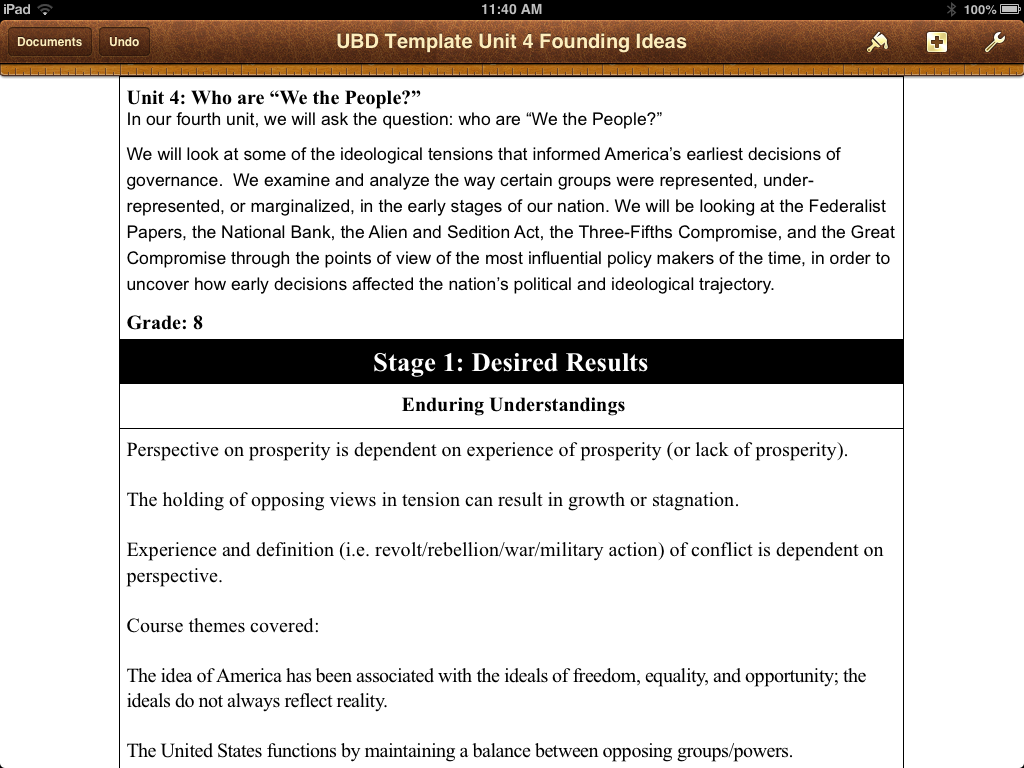
Click here for access to any of our unit overview pages for U.S. history; please understand that these are, as always, works in progress. We would love any constructive feedback anyone has for us.
Step Two: Smartboard
We are lucky enough to work in a school that has Smartboards installed in every classroom; this is, of course, not the case for everyone. Smartboard software is great for scripting out lesson plans because it allows for a screen-shade to hide and then reveal parts of a lesson on a single page. Another collaborator we worked with to craft these units and lessons (giving credit here to Aaron Brock for helping to craft this U.S. history curriculum) scripted these lessons out in Powerpoint for use in his classroom.
We script our lessons out on Smartboard software because it allows us to stay on track--unless we purposefully decide to take the lesson in another direction for clarification purposes or student need.
Another MAJOR advantage of scripting lessons out is that students are able to see the question that is being asked, as well as hearing it. Teachers don't have to turn their backs on students to write directions out on the board and don't have to remind students of what question they are meant to be discussing over and over. We have found this to be incredibly helpful with all students, but obviously most for students who have auditory processing challenges.
A usual lesson will contain an anticipatory set that is usually constructivist in nature (not always of course)--something that will get students' attention, activate prior knowledge, and give a thematic taste of the lesson's contents. Then, the meat of the lesson is scripted out using the Smartboard software. A copy of a "normal" lesson can be found here.
Our lessons tend to be experiential and collaborative; students work together to uncover information. The teacher is not seen as the source of information, but rather a facilitator.
The lesson ends with some kind of closure: a discussion, reflective writing, exit cards etc. in order to assess and wrap-up the day's concepts. The closure, as with the rest of the lesson, is scripted out so that any directions the students are following, or questions the students are answering are right there.
Lessons are always scaffolded so that the smaller parts of the unit come together for the larger assessment at the end; it is the goal that each lesson is a smaller piece in the larger unit puzzle. This culminates in the unit assessment.
Step Three: Haiku
Our middle school utilizes the Haiku Learning Management Program (more about the benefits of that later) in order to convey course material to students, and to provide a platform for in class and out of class interactions. As such, all of our course materials that are intended for students (lessons, handouts, directions, readings, images, videos, links, etc.) are found on our course Haiku page.
This allows for students to review lessons, activities, or catch up due to absence.
As the UBD overviews are not for students, they are not made available for them to see.
Step Four: The Purple Notebook
For such big proponents of tech, our method of reflection is decidedly "old school." There is a purple notebook on Shara's desk in our shared classroom where we write changes that we need to make to the lessons based on what went well, what didn't, etc.
From past experience, we have learned that it is vitally important to be as specific as possible when explaining to your future self what changes you want to make. Too often we have been flummoxed as to what we meant by "change the rubric" or such vague entries, that we were, at the time, so sure were self-explanatory.
There are so many parts to lesson planning processes that we left out of this post; it was getting too long as it was. The factors that go into crafting units and lessons are innumerable; please let us know if there is any point we can expound upon or clarify!
Subscribe to:
Posts (Atom)